


Most healthcare leadership writing comes from outside the rooms where decisions get made. This one does not.
I am David Wild. I have spent more than two decades moving between two kinds of rooms: the clinical ones, where I still practice anesthesiology a few shifts a month, and the administrative ones, where the conditions for that clinical work get set, the boardroom, the credentialing committee, the contracting table. Most clinicians only ever stand in one kind. Past the Door is my attempt to describe the other ones plainly, and to trace the line from each of them to the bedside, where the consequences land.
If you read one thing first, read the map.
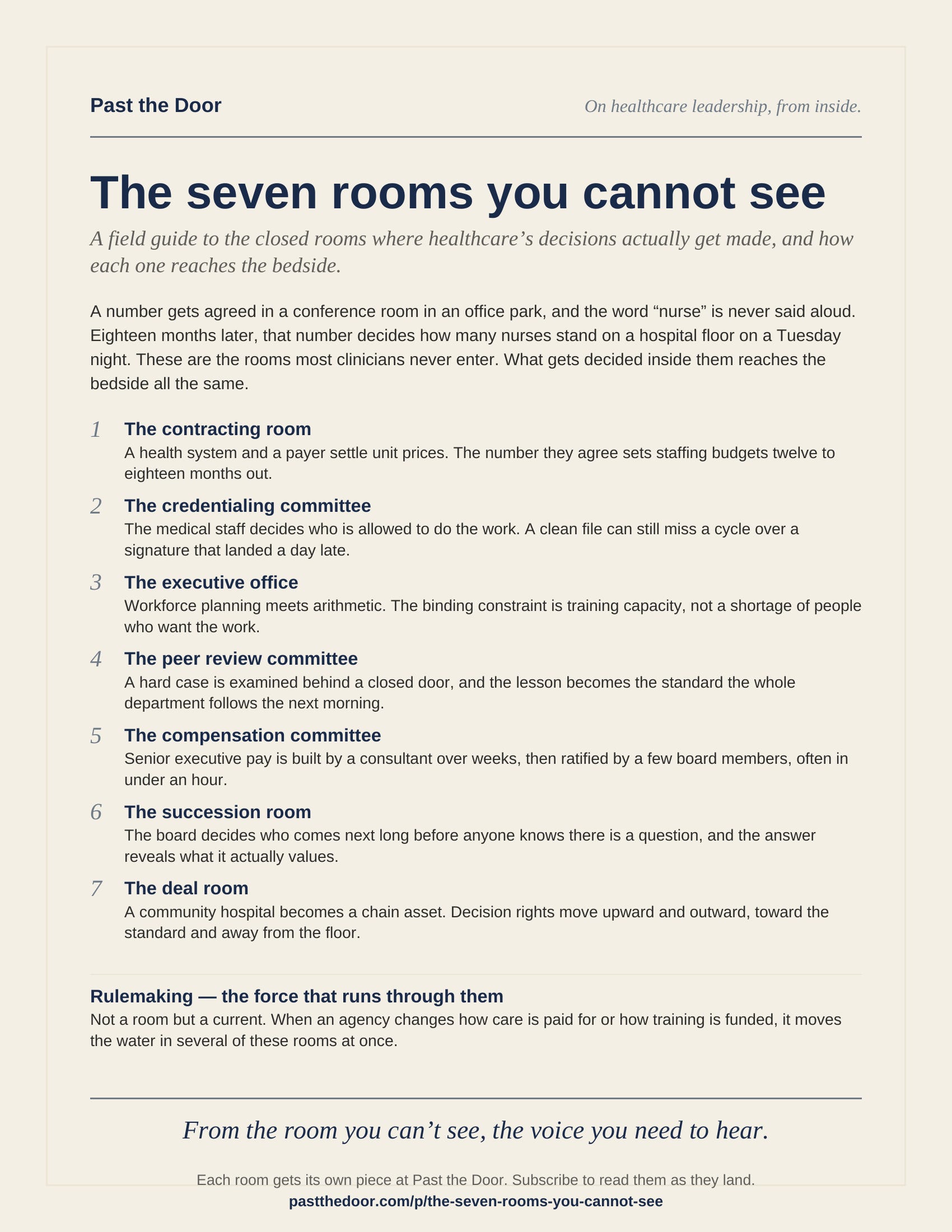
The seven rooms you cannot see is the anchor of everything here. It names the seven closed rooms where healthcare’s decisions actually get made, and gives each one a line. The image above is the keepable version, a single page you can save or send to a colleague. The full piece, with the sourcing, is the pillar it comes from.
Where to begin reading
The map orients; the room pieces go inside. A few places to start, depending on what brought you here.
For the origin, start with the inaugural, The rooms you can’t see. It is the three-in-the-morning version of why I write this.
For a room in depth, start with credentialing, the first one mapped fully. What You’re Actually Asking For is the applicant’s side; Inside the Credentialing Committee is the room itself.
For the leadership thread, What Clinicians Get Wrong Moving to Administration, written with Tracy Young, is on the translator role and the identity cost of the move, and The Coach Who Became a Mentor sits beside it.
For why any of this matters to me, After the Transplant is the most personal thing here.
The rest of the rooms, contracting, the executive office, peer review, compensation, succession, and the deal room, each get their own piece in the weeks ahead. Subscribing is how you get them as they land.
One ask, and it is a real one. Reply to the welcome note, or leave a comment below, and tell me which room you most want to understand. I read every response, and it shapes what I write next.
From the room you can’t see, the voice you need to hear.